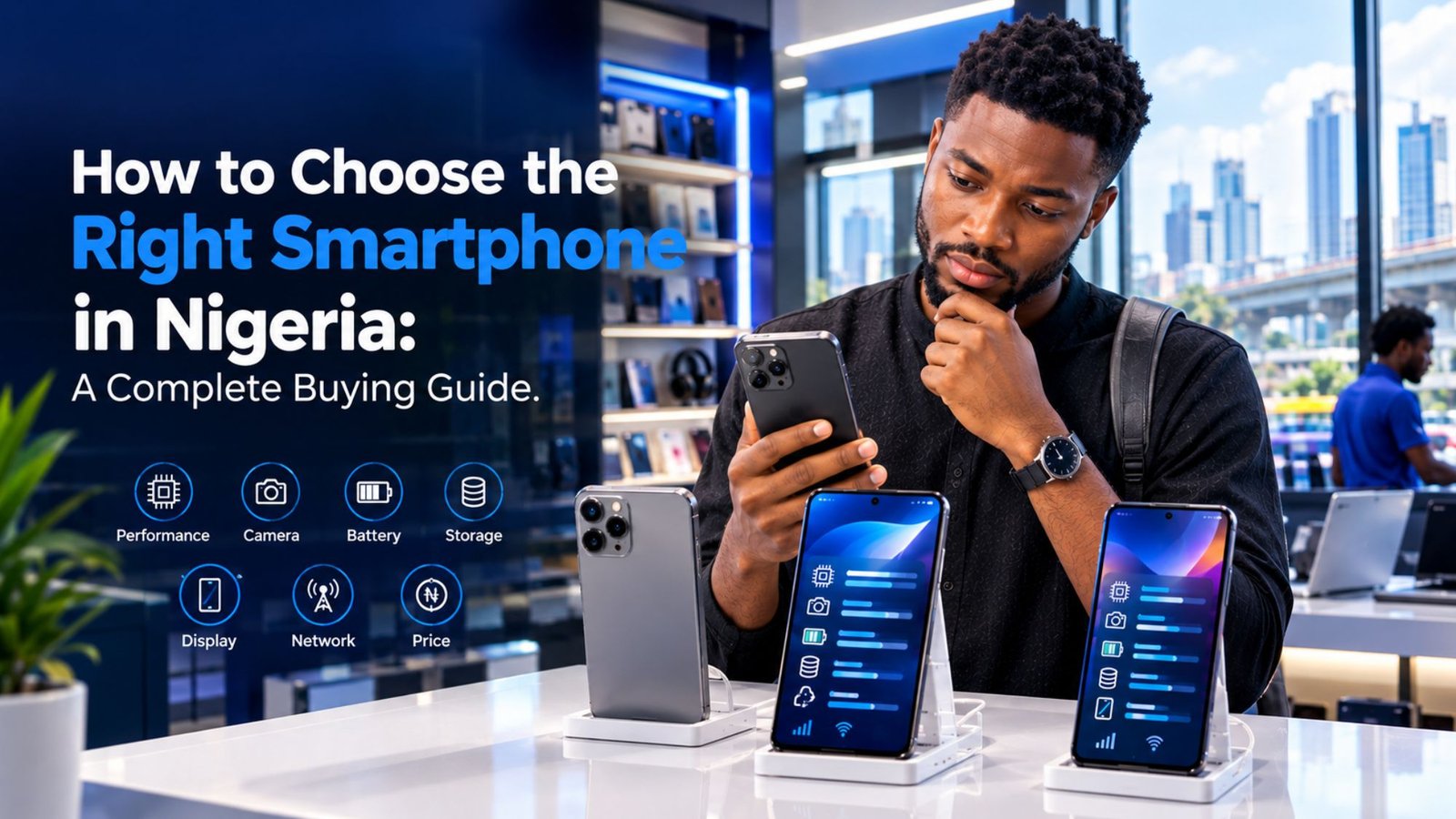
Buying a new smartphone in Nigeria can be confusing. With so many brands, models, specifications and price ranges available, it is easy to focus on the wrong features or spend more than necessary.
The best smartphone is not always the most expensive one. Instead, the right phone should match your budget, daily activities and personal needs.
Whether you need a phone for social media, photography, gaming, business, school or everyday communication, there are several important things to consider before making a purchase.
In this complete guide, we explain how to choose a smartphone in Nigeria by looking at performance, camera quality, battery life, storage, display, network support, software and price.
1. Start With Your Budget
Before comparing smartphone specifications, decide how much you are comfortable spending.
Smartphones in Nigeria are available across a wide range of prices. Setting a budget first helps you narrow your options and prevents you from paying for features you may not actually need.
For example, someone looking for a reliable phone for WhatsApp, calls, browsing and social media may not need the same hardware as someone who plays demanding games or edits videos.
When setting your budget, also consider additional costs such as:
- Phone case
- Screen protector
- Charger
- Earbuds or headphones
- Power bank
- Warranty or after-sales support
Most importantly, do not choose a phone simply because it has the highest price. Look for the best combination of features within your budget.
2. Choose the Right Performance Level
Performance determines how quickly your smartphone opens apps, handles multitasking and runs demanding applications.
The processor, RAM and software optimization all contribute to the overall experience.
If you mainly use your phone for calls, messaging, browsing and social media, a mid-range processor can provide more than enough performance.
However, gamers and power users should look for a more powerful chipset and sufficient RAM.
How much RAM do you need?
For basic everyday use, 6GB of RAM can be sufficient.
For heavier multitasking, 8GB or more provides additional headroom. If you regularly use demanding applications, edit videos or play graphics-intensive games, consider phones with higher RAM configurations.
Keep in mind that RAM alone does not determine performance. A phone with 12GB RAM is not automatically faster than one with 8GB RAM. The processor, storage technology and software also matter.
3. Pay Attention to the Display
Your smartphone’s display is something you will use every day, so it deserves serious consideration.
Look at three main factors: screen size, panel technology and refresh rate.
An AMOLED or OLED display generally provides deeper blacks, stronger contrast and vibrant colours. LCD screens, however, can still offer good quality, especially on affordable smartphones.
A higher refresh rate, such as 90Hz or 120Hz, can make scrolling and animations feel smoother than a traditional 60Hz display.
Also consider brightness.
This is particularly important in Nigeria because you may frequently use your phone outdoors in bright sunlight. A display with strong peak brightness will be easier to read outside.
4. Don’t Buy a Phone Based Only on Camera Megapixels
Camera specifications can be misleading.
A smartphone with a 200MP camera is not automatically better than a phone with a 50MP camera.
Image quality depends on several factors, including the sensor, lens, image processing, stabilization and software.
When comparing smartphone cameras, look for:
- Main camera quality
- Ultrawide camera
- Telephoto or zoom capability
- Optical image stabilization
- Night photography
- Video recording
- Front camera quality
If you create content for TikTok, Instagram or YouTube, video quality should also be a major consideration.
For casual photography, however, a good main camera with reliable image processing may be more useful than a large megapixel number.
5. Consider Battery Capacity and Charging
Battery life is particularly important if you spend long hours away from a charger.
A smartphone’s battery capacity is usually measured in mAh. A larger battery can provide longer usage, but capacity is not the only factor.
Processor efficiency, display technology, screen brightness, network connectivity and software optimization all affect battery life.
For many users, a phone with a battery around 5,000mAh provides a good starting point.
You should also consider charging speed.
Fast charging can be extremely useful when you need to quickly recharge your phone before leaving home. However, check whether the charger is included in the box because some manufacturers sell charging accessories separately.
6. Get Enough Storage
Running out of storage can become frustrating, especially if you take lots of photos and videos.
For basic users, 128GB can provide a reasonable amount of space.
If you download many applications, store large videos, take high-resolution photos or play large games, consider 256GB or more.
Also check whether the phone supports a microSD card.
Many premium smartphones no longer include expandable storage, so choosing the right internal storage capacity at the time of purchase is important.
7. Check 4G and 5G Network Support
Network compatibility should be high on your checklist when buying a smartphone in Nigeria.
Before purchasing, confirm that the phone supports the appropriate 4G LTE and 5G bands for your network provider.
This is especially important when buying imported or international versions of smartphones.
A phone can have excellent specifications but still provide a poor experience if it does not properly support the network bands used in your area.
You should also check:
- Dual-SIM support
- eSIM availability
- 4G LTE compatibility
- 5G support
- Wi-Fi standards
- Bluetooth version
If you frequently travel between cities or rural areas, reliable network support becomes even more important.
8. Look at Software and Updates
The software experience can make a major difference over several years.
Android smartphones from different manufacturers can offer very different interfaces and features. Apple uses iOS, while manufacturers such as Samsung, Xiaomi, Google and others provide their own Android-based experiences.
Before buying, consider how long the manufacturer promises to provide:
- Android or iOS updates
- Security updates
- Bug fixes
- New features
A phone that receives regular software updates can remain useful for much longer.
You should also consider whether you prefer Android’s flexibility or Apple’s ecosystem and simplicity.
9. Don’t Ignore Build Quality
A smartphone is an expensive device that you may carry every day, so build quality matters.
Look at the materials used for the frame and back panel. Also check whether the phone has an official water- and dust-resistance rating.
For example, an IP rating can provide additional protection against water and dust. However, it does not mean you should intentionally expose your phone to water.
A good protective case and screen protector are still worthwhile investments.
10. Consider Your Actual Usage
One of the easiest ways to choose the right smartphone is to think about what you actually do with your current phone.
Ask yourself:
Do I take lots of photos?
Prioritize camera quality and storage.
Do I play games?
Look for a powerful processor, good cooling, high refresh rate and a large battery.
Do I work from my phone?
Consider display size, multitasking, battery life and productivity features.
Do I create videos?
Look for strong cameras, stabilization, good microphones and sufficient storage.
Do I mainly use WhatsApp, calls and social media?
You may not need an expensive flagship smartphone.
This approach helps you spend your money on features that will actually improve your experience.
11. Check the Phone’s Warranty and Source
Price should not be your only consideration when buying a smartphone in Nigeria.
A cheaper device from an unreliable source may become expensive if you experience problems and cannot access proper support.
Before purchasing, check:
- Whether the phone is brand new
- Whether it is officially refurbished or used
- Warranty coverage
- Return policy
- Accessories included
- IMEI information
- Regional model number
If you are buying an imported smartphone, confirm that the model is compatible with Nigerian networks and understand what type of warranty is available.
12. Compare Before You Buy
Once you have identified a few smartphones, compare them directly.
Don’t simply compare megapixels or RAM. Look at the complete package.
For example, one phone may have a better camera while another offers a faster processor. A third might provide better battery life at a lower price.
Create a simple comparison based on:
| Feature | What to Look For |
|---|---|
| Price | Fits your actual budget |
| Processor | Suitable for your workload |
| RAM | 6GB–8GB+ depending on usage |
| Storage | 128GB minimum for many users |
| Display | AMOLED/OLED and 90Hz–120Hz where possible |
| Camera | Sensor quality, stabilization and processing |
| Battery | Around 5,000mAh for strong everyday use |
| Charging | Faster charging can be useful |
| Network | 4G/5G compatibility in Nigeria |
| Software | Long-term update support |
| Warranty | Reliable after-sales protection |
Final Thoughts
Learning how to choose a smartphone in Nigeria does not require becoming a technology expert.
The most important step is understanding your own needs.
Start with your budget, then consider performance, display, camera, battery, storage and network compatibility. After that, look at software support, build quality and warranty.
Most importantly, avoid buying a smartphone simply because it has impressive numbers on the specification sheet. A 200MP camera, 16GB of RAM or an extremely powerful processor may sound impressive, but those features only matter if they improve the way you use your phone.
The best smartphone is the one that gives you the right balance of performance, features, reliability and value for your money.
Before making your final decision, compare several models and verify the latest price, stock availability, specifications and warranty.
For Nigerian shoppers, this approach can help you make a smarter purchase and find a phone that continues to serve you well long after the excitement of a new device wears off.